|
Location: 15-km Southeast Of Leh,
Ladakh Region
Main Attractions: The Summer Palace & Shey Gompa,
The Temple Of Shakyamini, Ancient Monument
Historical Significance: Erstwhile Capital Of Ladakh.
Monastic Festivity: The Metukba Festival
Shey, 15-km southeast of Leh and once the capital of Ladakh is
now all but deserted, the royal family having been forced to
abandon it by the Dogras midway through the last century. Only a
semi derelict palace, a s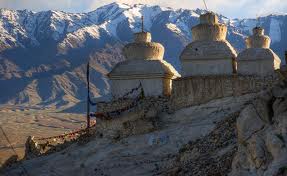 mall
Gompa and a profusion of Chortens remain, clustered around a
bleached spur of rock that juts into the fertile floor of the
Indus valley. mall
Gompa and a profusion of Chortens remain, clustered around a
bleached spur of rock that juts into the fertile floor of the
Indus valley.
The ruins overlook the main highway, and can be reached on the
frequent minibuses between Leh bus stand and Tikse.
Alternatively, one can walk to Shey from Tikse monastery along a
windy path that passes through one of Ladakh's biggest Chorten
fields with hundreds of white washed shrines of varying sizes
scattered across the surreal desert landscape. One can get
extremely dehydrated along the 4-km trek so bring plenty of
water and a hat.
Shey Old Palace
The palace, a smaller and more dilapidated version of the one in
Leh , sits astride the ridge below an ancient fort. Crowned by a
golden Chorten spire, its pride and joy is the colossal metal
Shakyamuni Buddha housed in its ruined split-level temple.
Installed in 1633 at the behest of Sengge Namgyal's son Deldan,
the twelve-metre icon allegedly contains a hoard of precious
stones, 'Manadalas' and powerful charms.
Entering from a painted antechamber lined with shelves of
ancient manuscripts, and exquisite murals, which have been
undergoing extensive restoration, one passes through heavy
wooden doors to come face to face with the Buddha's huge feet,
soles pointing upwards. The customary circumambulation leads
around the base of the statue through a haze of incense smoke to
total darkness behind.
Upstairs, from a balcony surrounding the statue's torso, one can
see the massive Buddha, painted gold with tightly curled blue
hair, in better light, and inspect the magnificent paintings of
Buddhas, Bodhisattvas, Mahasiddhas and fierce protector deities
coating the temple walls. Preserved for centuries by thick soot
from votary butter lamps, these are among the finest in the
valley, painted in stunning detail and tinted with gold applied
with smooth hair fine brush strokes.
Shey's Festivity Shey Festival
In July the Metukba festival takes place in the Shey Gompa with
one day of prayers for the well being of all life in the entire
world. The upper chapel of the Shey Gompa is used for everyday
functions; it surrounds the Buddha figure's head as a sort of
balcony. The lower, somewhat larger, chapel houses a large
collection of Thankas and a library. All the old Thankas bear
the stamp of the 'Gompa Association, Ladakh '.
The best time to visit the Shey Gompa is between 7.00 and 9.00
am or 5.00 and 6.00pm since the monks perform their prayer
devotions at these times. The Gompa is usually closed to the
public at other times. Near Shey there is a field with an
impressive collection of hundreds of small Stupas and Mani
Walls.
The Temple Of Shakyamini
Fine minutes walk across the fields from the palace, in the
centre of a Chorten strewn plain, stands a temple, enshrining
another massive Shakyamuni statue (Daily 7.00 am - 9.00 am &
5.00 pm - 6.00 pm). Best viewed from the mezzanine verandah on
the first floor, it is slightly older than its cousin up the
hill. The descendants of the Nepali metalworkers who made it,
brought here by Sengge Namgyal, still live and work in the
isolated village of chilling famous for its traditional silver
ware. Downstairs, the Gompa's Du-khang contains dusty old
Thangkas and manuscripts.
Shey LakeShey's Ancient Monument
Easily missed as one whizz past on the road is Shey's most
ancient monument. The rock carving of the five 'Tathagata' or
"Thus gone" Buddhas, distinguished by their respective vehicles
and hand positions, appears on a smooth slab of stone on the
edge of the highway; it was probably carved soon after the 8th
century, before the "Second Spreading". The large central figure
with hands held in the gesture of preaching (turning the wheel
of Dharma), is the Buddha Resplendent, Vairocana, whose image is
central in many of the Alchi murals.
Shey Oracle
As in Mulbekh, Tikse, Matho, Stok and other Ladakh villages,
Shey has an oracle. During the Shey Shublas, the August harvest
festival, the Shey oracle rides on a horse and stops at various
places around Shey to prophesise the future. The oracle, a Shey
layman, starts at the Tuba Gompa where he engages in a two or
three day prayer, while in a trance, in order to be possessed
and become an oracle.
The Shey oracle is held in the highest regard and viewed as a
God who has achieved the highest level of existence. Other
oracles, especially those in Tikse and Stok, are not so well
regarded, but are at the same time feared and revered because of
their spiritual state. It is said that if one asks a question of
an oracle, but disbelieves the answer and goes to another
oracle, no answer will be given.
HOW TO GET THERE
Road: Regular minibuses ply from Leh and Tikse. |