|
Area:
97,000 sq kms out of which nearly 38,000 sq. kms are under
Chinese Occupation since 1962.
Population: Approx. 2.40 lakh in
the 2 districts of Leh & Kargil.
Languages: Ladakhi including Balti / Purgi, Shina or Dardic,
Urdu / Hindi.
Ethnic composition: Mongoloid/Tibetan, Dardic and assorted
Indo-Aryan elements.
Altitude: Leh 3505 m, Kargil 2750 m
|
Temperature: |
Maximum |
Minimum |
|
Summer |
25oC |
8oC |
|
Winter |
(-) 5oC |
(-) 20oC |
Rain-fall :
15cm, 6" (annual average)
Clothing :Cotton
& light woollens in summer and heavy woollens including
down-filled wind proof upper garments in winter.
Geographical Introduction
Ladakh is a land abounding in awesome
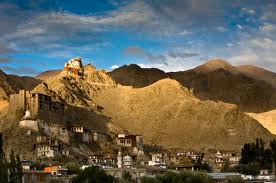 physical features, set in
an enormous and spectacular environment. Bounded by two of the
world's mightiest mountain ranges, the Karakoram in the north
and the Great Himalaya in the south, it is traversed by two
other parallel chains, the Ladakh Range and the Zanskar Range. physical features, set in
an enormous and spectacular environment. Bounded by two of the
world's mightiest mountain ranges, the Karakoram in the north
and the Great Himalaya in the south, it is traversed by two
other parallel chains, the Ladakh Range and the Zanskar Range.
In geological terms, this is a young land,
formed a few million years ago. Its basic contours, uplifted by
tectonic movements, have been modified over the millennia by the
process of erosion due to wind and water, sculpted into the form
that we see today.
A
Virtually Rainless Area
Today a
high-altitude desert, sheltered from the rain-bearing clouds of
the Indian monsoon by the barrier of the Great Himalaya, Ladakh
was once covered by an extensive lake system, the vestiges of
which still exist on its south-east plateaux of Rupshu and
Chushul, in the drainage basins or lakes of Tso-moriri, Tso-kar
and Pangong-tso. But the main source of water is winter
snowfall.
For the rest of the region, the snow on the peaks is virtually
the only source of water. As the crops grow, the villagers pray
not for rain, but for sun to melt the glaciers and liberate
their water. Usually their prayers are answered, for the skies
are clear and the sun shines for over 300 days in the year.
Dras, Zanskar and the Suru Valley on the Himalaya's northern
flanks receive heavy snow in winter, this feeds the glaciers
from which melt water, carried down by streams, irrigates the
fields in summer. For the rest of the region, the snow on the
peaks is virtually the only source of water. As the crops grow,
the villagers pray not for rain, but for sun to melt the
glaciers and liberate their water.
Leh, the capital of Ladakh is situated at a
height of 3505 meters. Leh is a beautiful destination with so
many attractions and is the center of Tibeto-Buddhist Culture
for ages. Its colorful gompas have attracted the devout
Buddhists from all over the globe. Besides, it is also a
favorite hiking locale and is known for some of the best hikes
in the country.
Weather of The Cold Desert
Ladakh lies at altitudes ranging from about
9,000 feet (2,750m) at Kargil to 25,170 feet (7,672m) at Saser
Kangri in the Karakoram. Thus summer temperatures rarely exceed
about 270 C in the shade, while in winter they may plummet to
-200 C even in Leh. Surprisingly, though, the thin air makes the
heat of the sun even more intense than at lower altitudes; it is
said that only in Ladakh can a man sitting in the sun with his
feet in the shade suffer from sunstroke and frostbite at the
same time!
What to Do and See in Ladakh
Ladakh has nonetheless retained a more
tranquil side, and is a pleasant place to unwind after a long
bus journey. Attractions in and around the town itself include
the former Palace and Namgyal Tsemo Gompa, perched amid strings
of prayer flags above the narrow dusty streets of the Old
Quarter. Ladakh is also a good base for longer day trips out
into the Indus Valley. Among the string of picturesque villages
and Gompas within reach by bus are Shey,
site of a derelict 17th century palace, and the Spectacular
Tikse Gompa. Untill one has adjusted to the altitude, however,
the only sightseeing one will probably feel up to will be from a
guesthouse roof terrace or garden, from where the snowy summits
of the majestic Stok-Kangri massif (6,120m ).
Ladakh offers great opportunities for undertaking adventure
activities amidst landscapes of breathtaking, rugged beauty. The
most popular and best established among these aretrekking,
mountaineering and river rafting. more...
Trekking in Ladakh
The captivating landscape, with an
incomparable diversity of flora and fauna: Ladakh is regarded as
the 'trekkers' paradise' and, indeed, is a refreshing treat to
the trekkers. Ladakh is the ultimate destination for a trekking
holiday, offering everything from short and easy excursions to
the long challenges of the snowy peaks, invoking visions of the
spectacular views, the lush meadows, green woodland and fragrant
orchards. Ladakh and its adjoining areas like Zanskar valley
provide excellent trekking routes, which allow the traveller to
visit the remote village in the far-flung area of these regions.
The high mountain passes, monasteries, yak herds on the high
slopes would all give a feeling of the land beyond. more...
Buddhism in Ladakh
The dominant
religion of Ladakh is Buddhism, and it is the living religion of
the people here, the practice of which has enabled them to live
in complete peace not only with other religions but also with
the nature. It is manifest in the art and architecture of Ladakh.
The monasteries, or the gompas as they are called, are
beautifully designed and have the finest of sculptures, wood
carvings, bronzes, gold and silver chortens, paintings done on
silk scrolls and walls and scriptures printed out of hand-made
wooden blocks. In the monasteries the devout pray for the peace
of the world. more...
Festivals of Ladakh
The centuries -old
culture of Ladakh has found expression in its monuments,
monasteries, oral literature, art forms and fairs and festivals.
And in the time-honoured tradition of collective celebration ;
every occasion -marriage , birth , harvesting or even the
flowering of plants is marked by feasting, dancing and the
singing of folk songs that form a part of its living heritage more...
How to Reach Ladakh
By Air: The
nearest airport is Leh. There are flights from Delhi, Chandigarh
and Srinagar.
By Road: There
are two overland routes the Srinagar to Leh road remains open
from early June to November. The Jammu and Kashmir State Road
Transport Corporation operates regular deluxe and ordinary bus
services.
Manali - Leh
road remains open from mid June to early October. Himachal
Pradesh tourism, HRTC and Manali private bus union, operates a
daily bus services, which takes two days to reach Leh, after a
night halt at Sarchu or Darcha.
Taxi - Taxies
are also available at Leh, Manali and Srinagar.
Hotels in Ladakh
Check out the Ladakh Hotels Guide offering
a list of options to get online Hotel bookings and instant hotel
reservations before planning your trip to Ladakh.
Click Here For Hotels
Booking in Ladakh |