|
One of the holy tri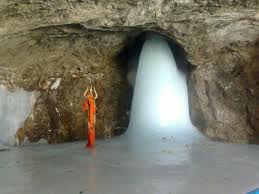 nity,
Shiva is a living god. The most ancient and sacred book of
India, the Rig Veda evokes his presence in its hymns. Vedic
myths, ritual and even astronomy testify to his existence from
the dawn of time. nity,
Shiva is a living god. The most ancient and sacred book of
India, the Rig Veda evokes his presence in its hymns. Vedic
myths, ritual and even astronomy testify to his existence from
the dawn of time.
Shiva is known to
have made his home in the Himalayas. He built no house nor
shelter, not for himself or his bride. He was an ascetic, and
yet married; he could be both for "he was the wild god sporting
in the forest or taking his ease on a cloud."
Legend has it that
Shiva recounted to Parvati the secret of creation in the
Amarnathji cave. Unknown to them, a pair of mating pigeons
eavesdropped on this conversation and having learned the secret,
are reborn again and again, and have made the cave their eternal
abode. Many pilgrims report seeing the pigeons-pair when they
trek the arduous route to pay obeisance before the ice-lingam
(the phallic symbol of Shiva).
|
 |
 |
|
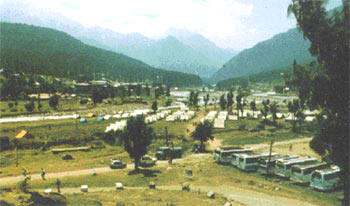
Yatra
arrangements at Pahalgam |
The trek to
Amarnathji, in the month of Shravan (July - August) has the
devout flock to this incredible shrine, where the image of
Shiva, in the form of a lingam, is formed naturally of an ice -
stalagmite, and which waxes and wanes with the moon. By its side
are, fascinatingly, two more ice - lingams, that of Parvati and
of their son, Ganesha.
According to an
ancient tale, there was once a Muslim shepherd named Buta Malik
who was given a sack of coal by a sadhu. Upon reaching home he
discovered that the sack, in fact, contained gold. Overjoyed and
overcome, Buta Malik rushed back to look for the sadhu and thank
him, but on the spot of their meeting discovered a cave, and
eventually this became a place of pilgrimage for all believers.
To date, a percentage of the donations made by pilgrims are
given to the descendants of Malik, and the remaining to the
trust which manages the shrine.
Yet another legend
has it that when Kashap Reshi drained the Kashmir valley of
water (it was believed to have been a vast lake), the cave and
the lingam were discovered by Bregish Reshi who was travelling
the Himalayas. When people heard of the lingam, Amarnathji for
them became Shiva's abode and a centre of pilgrimage.
|
 |
|
|
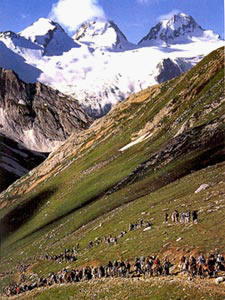
The Yatra
Procession |
Whatever the legends
and the history of Amarnathji's discovery, it is today a very
important centre of pilgrimage and though the route is as
difficult to negotiate as it is exciting, every year, thousands
of devotees come to pay homage before Shiva in one of his famous
Himalayan abodes.
Situated in a narrow
gorge at the farther end of Lidder valley, Amarnathji stands at
3,888 m and is 45 km from Pahalgam and 141 km from Srinagar.
Though the original pilgrimage subscribes that the yatra be
undertaken from Srinagar, the more common practice is to begin
the journey from Pahalgam, and cover the distance to Amarnathji
and back in four or five days. Pahalgam is 96 km from Srinagar.
Since the base point
for the pilgrim's trek is picturesque Pahalgam, a large tented
township springs up to accommodate the pilgrims. The conduct of
the yatra is a gigantic task in which the State Government takes
the assistance of the security departments for providing
security and helping to keep the route open. All intermediate
halting places have the same kind of facilities as are provided
at Pahalgam, and a Yatra
Officer is appointed to conduct the pilgrimage. |