|
Trekking
possibilities include short, daylong walks up and down mountain
slopes to visit isolated villages or monastic settlements, or
across a ridge to enjoy the sheer beauty of the
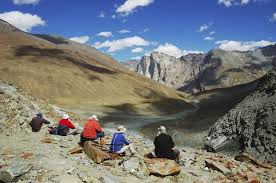 lunar
mountainscape. Or long, trans-mountain treks involving weeks of
walking and camping in the wilderness. For example, the trek
from Lamayuru in the Indus valley to Darcha in Lahaul across
Zanskar takes nearly three weeks. Most of the established routes
traverse the Zanskar range, which separates the Indus valley
from separates the Indus valley from Zanskar. lunar
mountainscape. Or long, trans-mountain treks involving weeks of
walking and camping in the wilderness. For example, the trek
from Lamayuru in the Indus valley to Darcha in Lahaul across
Zanskar takes nearly three weeks. Most of the established routes
traverse the Zanskar range, which separates the Indus valley
from separates the Indus valley from Zanskar.
The 10 day Lamayuru-Padum traverse and the Stok-Khangri round
trek are the more popular ones among the numerous options
available in this convoluted mountain mass. In recent years,
parts of the Ladakh range between the Indus and Shayok valleys
have also become available for trekking.
The Trekking Season
The traditional trekking seasons extends from early June to
mid-October. But localised treks within the Indus Valley can be
undertaken even in May. On the other hand, some routes are
suitable only for late autumn, as during the summer, the bed of
narrow valleys through which the tracks lied become turbulent
streams, as in the case of the 13-day Hemis-Markha-Padum trek.
The winter access to the Zanskar valley is actually along the
frozen surface of the Zanskar River. This route, known as "Chaddar",
calls for elaborate arrangements, but it is perhaps the most
exciting trek in the world.
Depending on the time and budget one can afford, ask the Tourist
Offices at Leh, Kargil or Padum to design a trekking program.
The easiest way to go on a trekking is through a travel agency,
which will take care of all arrangement s including capming
gear, provisions, porterage, staff, etc. But if one intends to
make one's own arrangements, it is advisable to carry as much
provisions and fuel from Leh or Kargil as possible. Please
remember that Ladakh is a harsh land where most villagers cannot
part with their foodstock. In some villages along the trek,
fresh yoghurt and some Tsampa can be procured, but these sources
cannot be relied upon. Kerosene or gas for cooking stoves must
be carried in sufficient quantity to last the duration of the
trek as fuel is unlikely to be available along most of the
route.
Keeping The Environment Clean
The Ladakh environment is ecologically fragile as the survival
of the inhabitants depends upon the land, despite its apparent
starkness. As such, it is absolutely important that trekkers
keep the routes and campsites clean and avoid disturbing the
region's delicate environment. Before striking camp, trekkers
and travel agents should ensure that no garbage is left
undisposed at the campsites. Plastic containers and polythene
wrappers must be incinerated, while other types of garbage
should be properly buried.
Requirements About Trekking In Ladakh
For trekking in Ladakh to be a rewarding experience, it is not
enough to be physically fit; intending trekkers must also be
prepared to face the rigourous to back country travel. There are
considerable fluctuations in day and night temperatures even
during the height of summer. While the days are pretty warm,
even hot, due to the desert effect of the barren landscape,
evenings can become chilly, requiring additional clothing.
It is, therefore, advisable to keep a pullover and/ or an anorak
handy. A sturdy pair of walking shoes with strong rubber or
synthetic soles for grip, thick cotton socks (woolen for autumn
trek or glacier walks) and a good sleeping bag together with an
insulated ground pad are essential gear for going on a trek even
if you may be passing through inhabited areas with the
possibility of accommodation in village homes or monasteries. In
case of extended treks across mountain passes or trans-mountain
traverses, a water-proof tent will have to be carried besides
provisions and cooking gear, all backpacked in a good quality
ruchsack.
Mulbek Valley
Additional requirements could include a Balclava, woolen
undergarments, wind Parkas, etc. Toiletries and first-aid kits
should include Lipsalve, moisturisers and suncream, water
purifying tablets, medicines for high altitude sickness, etc. A
good quality water canteen is must to carry the drinking water
so essential during high altitude trekking in arid conditions.
Do not forget to carry a flashlight with sufficient spare
batteries, a sun-hat and a pair of good quality sunglasses with
sufficient filter-factor to check the sun's brightness and
ultraviolet rays.
Shopping For Trekking Equipments
The J&K Tourism Department maintains trekking equipment hire
shops in its Srinagar, Leh and Kargil Offices. Imported items
like tow-man tents, insulated ground sheets, sleeping bags,
insulated jackets, trekking shoes and rucksacks are available at
these shops at reasonable charges fixed by the Government. Some
private establishments and, trekking agencies in Leh also
provide similar trekking gear on hire. |